

What is Stardew Valley?
Stardew Valley is a farming life simulator video game, released in 2019. The plot of the game starts with you inheriting your grandfather’s old farm plot in Stardew Valley. You have a small amount of money and a few tools to begin your new life. The game has overwhelmingly positive reviews with over 500,000 on Steam at the time of writing. All the information in this article is correct for the 1.5 version of the game, please let me know if I have missed anything or if you’d like to add your own ideas.
This article could not have been made without the Stardew Valley wiki and all information and pictures are from there or in-game, unless otherwise stated.
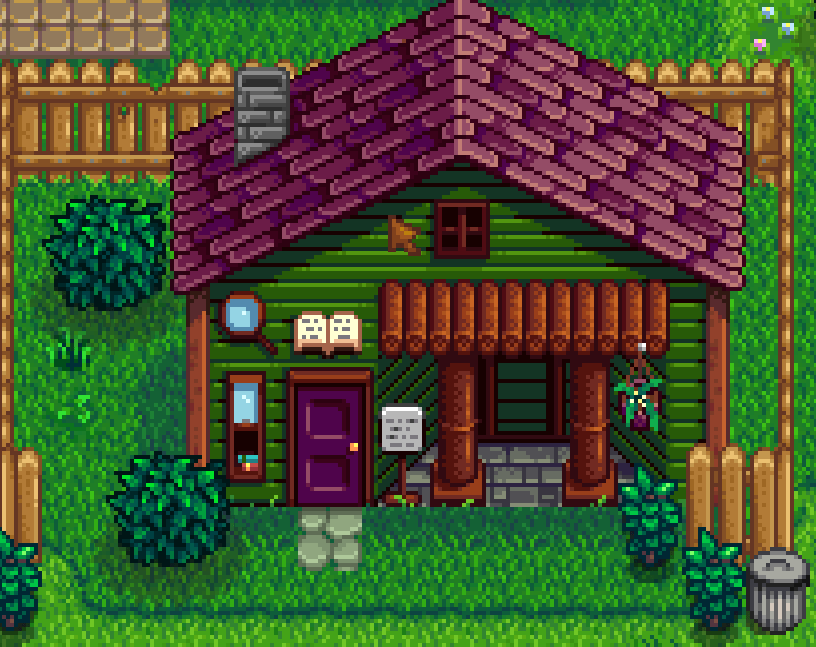
Stardew Valley Museum and Library

The Stardew Valley Museum and Library is located in the main town, Pelican Town. It is the Archaeological Office. Gunther is the local curator and librarian. At the start of the game, the Museum is completely empty and Gunther will ask the player to help fill it up. This is done by donating artefacts, minerals and lost books the player finds through gameplay.
The game quickly introduces Archaeology into the game by having an “Archaeology” quest that can be triggered early in the game – the player just has to enter the museum with an artefact or mineral in their inventory. The quest involves the player finding an artefact or mineral and then donating it to the museum, which is quite easily achieved.
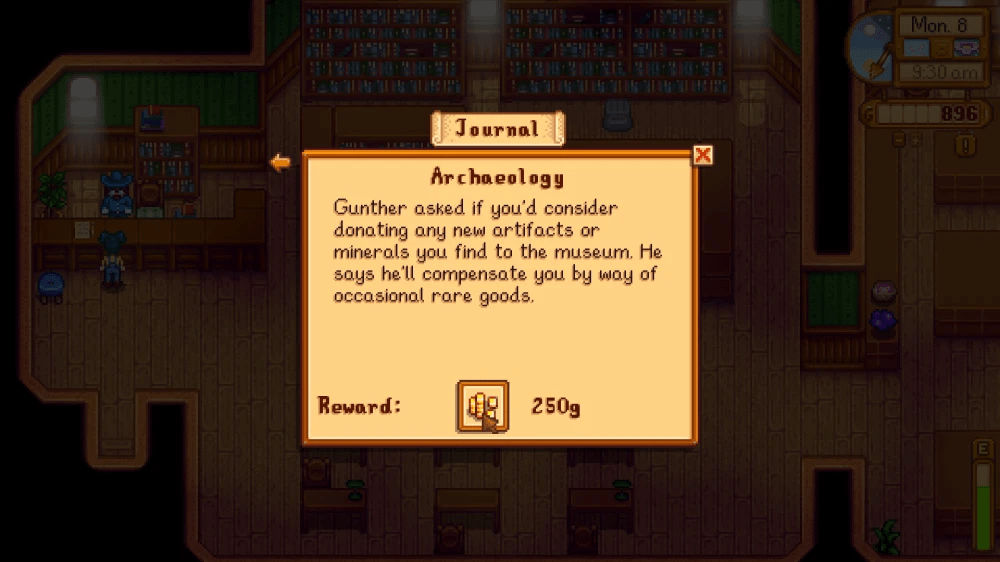
Artefacts can be found in numerous ways:
- Using the Hoe on an Artefact Spot
- Using the Hoe on dirt in the Mines
- Killing Monsters
- Fishing up Treasure Chests
- Breaking open Artefact Troves
None of these reflect real archaeological practice, well sometimes fishing does (see my article on Doggerland) so if the game was going to increase the archaeological component, this would be a fun addition!
Archaeological Artefacts in Stardew Valley

In total, there are 95 objects the player can find and donate to the museum, 53 minerals and 42 artefacts, and only a single copy of each can be donated.
When the player reaches certain donation thresholds and criteria, Gunther rewards them with various items. The reward for achieving 60 total donations triggers a cut scene where Gunther visits the player to thank them for their work and inform the player the museum has been awarded the “coveted ‘golden shovel’ award for our significant contributions to the field!”.
Once the player has donated an item, there isn’t much that can be done with duplicates. Some are used in crafting recipes and bundles. Most artefacts can only be sold for small amounts which is refreshing as there is no ‘Archaeology’ Treasuring Hunting aspect, unlike common archaeology elements in similar games, e.g. The Sims and Animal Crossing. It would be nice to see the game implement something else to do with the duplicate artefacts, potentially shipping them to other museums or researchers, with a chance of unlocking more information surrounding them.
Looking at the collection of artefacts and beginning to explore them individually most reassemble real archaeological finds and when you start to analyse this collection, it is possible to draw archaeological theories and chronolgies about Stardew Valley through time. Here are the artefacts that I have used for my archaeological analysis of Stardew Valley throughout time, organised into rough eras, types and locations.
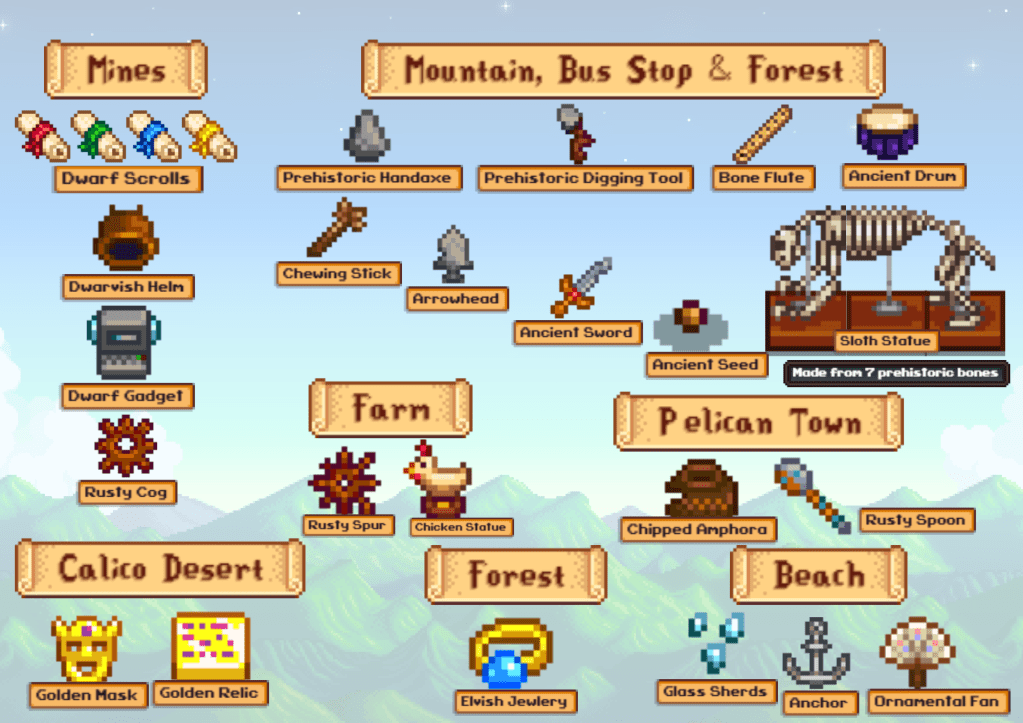
The Archaeological Eras of Stardew Valley
I will be using real-world terminology to explain these as we do not know the archaeological terminology or eras in the Stardew Valley Universe. All conclusions are my own interpretations and are open to debate!
The Elemental Era

The first identifiable era of occupation by a group of beings is, what I have termed, the Elemental Era. This most likely started before human occupation and the most active location of the valley was the mines, suggesting the above land may have been more inhospitable potentially due to an alternate climate. The Shadow People are the first known group to occupy this area and were eventually imposed upon by the Dwarves, however, they do not have any material remains just oral histories, which will be detailed later.

One of the main artefacts of the Dwarvish culture that the player can discover are the four Dwarvish Scrolls. Upon completing this set, the player gains the ability to understand the dwarvish language and is then able to communicate with the Dwarf who lives in the mines. The Dwarf is wary of humans and the shadow people as referenced through conversation. When the player reaches 6 hearts of friendship level with the Dwarf they state: “Long ago, my people knew the secrets of advanced technology. The archaeological evidence proves that. But I wonder where it came from? And where did it all go? I guess some questions will never be answered…”
There is archaeological evidence the player can discover that the Dwarf is referring to.
This includes the helm, rusty cog and dwarf gadget. Dwarvish artefacts are mostly likely to be uncovered in the mines area, suggesting that their settlement was based here.
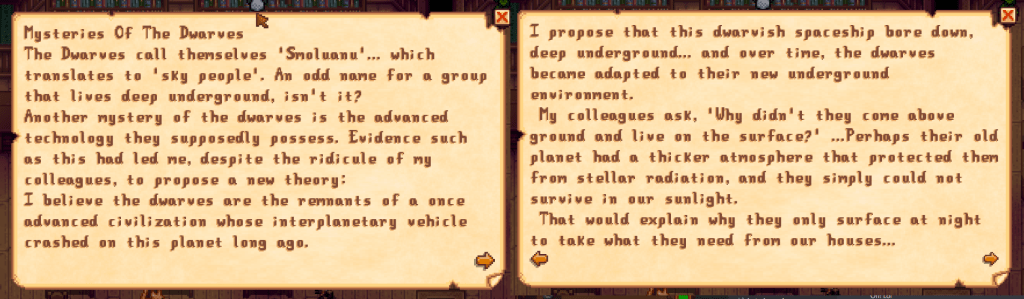
There has been some local research into the Dwarves as detailed in a lost book “Mysteries of the Dwarves” by M. Jasper. In summary, this interpretation believes that the Dwarves are ancient aliens who crashed into the Valley a long time ago, deep underground.

We only know of the coexistence with the shadow people through oral histories. The Dwarf is wary of Shadow People initially believing they have sent the player as a spy. The player encounters Shadow People as aggressive monsters in the mines. However, there is one friendly shadow person who lives in the sewers which the player can interact with, Krobus. Krobus is also wary of humans but equally of dwarves, scared the player will alert the dwarves to his location as they will send an assassin.
Later in the game, there is an event when the player enters the sewer to find the Dwarf and Krobus fighting, the Wizard is also there to intervene. When the Wizard intervenes, he references an event he called “The Elemental Wars” stating they are long over, but occurring in Krobus and the Dwarf’s lifetime. We are not sure how long ago this was but is still culturally very relevant for the Dwarves and Shadow People. It tells the player, that the Dwarves drove the Shadow People out of their ancestral lands, presumably the mines, and then war broke out.
It is unclear when the Elemental Wars ended but it is a long time ago. Considering both are also equally wary of humans, I believe the war eventually fizzled out to a mutually unhappy peace when human occupation of the valley began.
Human Prehistory
This leads nicely to the next era, Human Prehistory. In our own world, prehistory is usually broken up into the Stone Age, Bronze Age and Iron Age. The Stone Age is also further divided into 3 sections: the Paleolithic (Old), Mesolithic (Middle) and Neolithic (New).
In Stardew Valley, human occupation seems to follow a similar pathway but is less defined due to a lack of archaeological evidence. These are the artefacts I have deemed to fit into a prehistory Stardew Valley, several of which perfectly represent real archaeological artefacts, a few of which I have detailed below.

The Prehistoric Handaxe is described perfectly in the game as an archaeologist would an Acheulian handaxe – “One of the earliest tools employed by humans. This “crude” tool was created by striking one rock with another to form a sharp edge.“

Acheulian handaxes are probably the most distinctive archaeological artefacts. The name comes from the site where they were first identified, Saint‐Acheul in France. They are one of the oldest tools used by the human species with the oldest dating to approximately 1.76 million years ago and the newest to 200 thousand years ago, which is in the Paleolithic period. Most researchers believe they were used as cutting tools, however, this is still debated with some arguing they were throwing weapons or for social signalling. They are thought to have been produced by the human species Homo erectus and Homo heidelbergensis. These finds suggest the human species came to the valley very early in history.

The bone flute is another example which could also date to the Paleolithic. There are several examples of these. However, the oldest was discovered in 2008 when vulture bone flute fragments were excavated in a Stone Age cave in Germany and are estimated to be 40,000 years old.


Chewing sticks are the origins of toothbrushes and date to as early as 3,500 BCE in Babylon! There are records from 1,600 BCE in China which describe how one end of a stick was chewed until it became brush-like, then the other end was pointed to use as a toothpick. Ancient Greek and Roman literature also discussed using toothpicks to keep teeth clean.

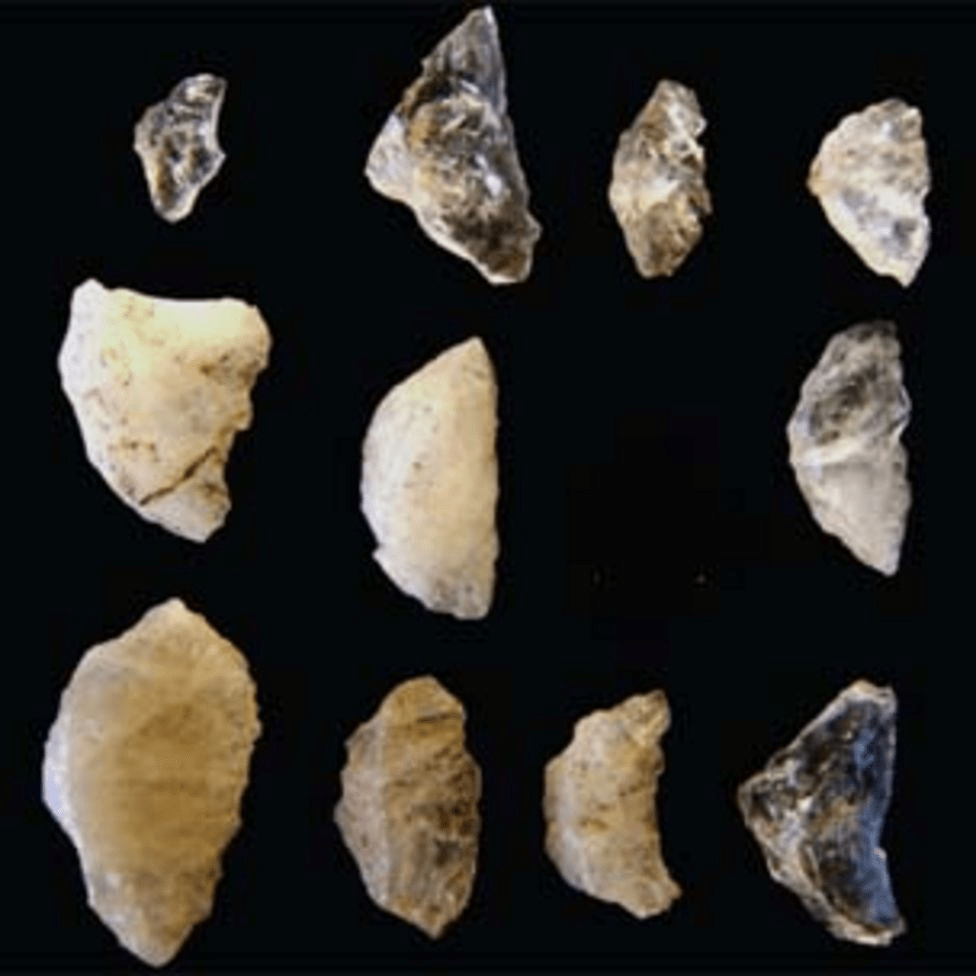
Throughout history, arrowheads have been used and developed with lots of different examples from all over the world. The earliest evidence of arrowheads are 64,000-year-old stone points which were found in South Africa.

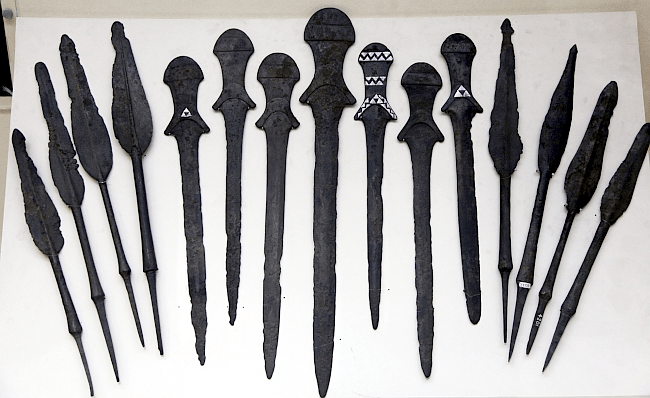
The oldest weapons that could be described as swords are from the site of Arslantepe in Turkey. Nine swords were discovered here in the 1980s and are 45-60 cm in length so are either short swords or long daggers. These are 5,000 years old, dating to around 3,300 BCE.

The Ancient Seed gives the possibility of archaeobotany to examine what the ancient farmers used to grow!

Zooarchaeology, the study of animals in the past, is also a component of this period. The player collects in total seven pieces of different prehistoric bones: scapula, tibia, skull, hand, rib, vertebrae and tail. When all the parts have been collected the player will have three parts of a sloth skeleton, creating a full one when placed together. This suggests that sloths frequently roamed the prehistoric Stardew Valley.
Interestingly, all of these potentially prehistoric finds are most likely to be uncovered in the Mountain, Forest and Bus Stop areas of the Valley, not in Pelican Town. These areas are all rich foraging areas and before the invention of farming in the Neolithic, humans were hunter-gatherers, that is if Stardew mimics our own prehistory patterns. Potentially early human occupation didn’t occur in the town or maybe the evidence there has been lost due to continuous occupation.
The Middling Era
These finds probably are in the middle but fit less defined chronological typologies.

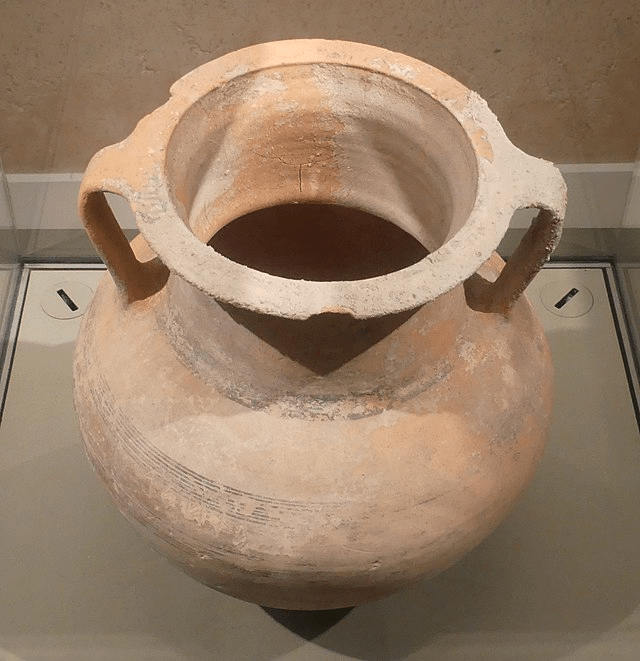
Chipped Amphora has prehistoric origins in real life but is mostly known for use by the Ancient Greeks and Romans. They were used as containers to store and transport a wide range of products, but most known for holding wine. This find is also typically uncovered in Pelican Town so is probably associated with later history as this seems to be the most recently settled area.

Glass Sherds are usually found at the beach and in games described as maybe coming from a mosaic or jewellery. There aren’t many examples of glass mosaic use but there are some Roman examples.


The rusty spur and chicken statue could also be from a wide range of periods but it allows us to conclude that people have been raising animals on the farm area for centuries with a particular affinity for chickens.

The Ancient Doll is hard to define to an era but interestingly is stated as being for ritual use, a phrase archaeologists love!


The Mask and Golden Relic don’t have a set parallel date. They are both exclusive to the desert suggesting that Calico Dessert had a settlement with a fondness for gold. The Golden Relic has hieroglyphics inscribed, which are an ancient Egyptian writing system.

There is also a period of Ancient Pirates, which seem to have visited the beach at some point with the anchor artefact as evidence.
Sixth-Era Tourism

The Ornamental Fan is described as most likely belonging to a noblewoman. Then also details that historians believe that the valley was a popular sixth-era vacation spot for the wealthy. We don’t know when the Sixth Era is but this appears to be closest to modern day when compared to our own modern perceptions. Hand fans can be traced to 4000 years ago in Ancient Egypt, two were even discovered in the tomb of Tutankhamun.
Unknown Periods

There is one other group of beings that have left material culture in the forest which is the Elves. The player can discover a piece of elvish jewellery, which has an undeciphered script on it and is of an unknown date.
Other beings in the game do exist, such as fairies and goblins, but there are no archaeological artefacts associated with them.
Modern

The Rusty Spoon is our archaeological artefact tying us to the modern day, which was probably dropped in the last 10 years! Archaeology isn’t always about the oldest things we find…
Island Field Office, Ginger Island
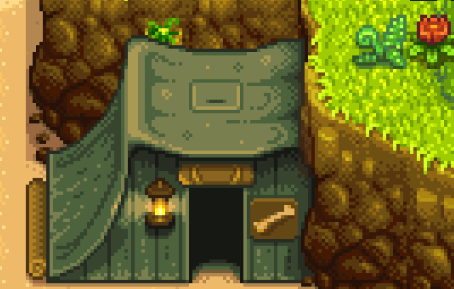

As a final point, another archaeological -ish research the player can do is on Ginger Island with Professor Snail. The player initially frees him as he is trapped in a cave and he then explains he has been conducting a survey of the island’s flora and fauna for a year. He occupies the Island Field Office on Ginger Island. He asks the player’s help in finding fossilised and mummified animal remains for his research into ancient animals that inhabited Ginger Island.
Conclusion
Stardew Valley definitely has a rich and fascinating archaeological record, that leaves scope for further research and new mechanics to examine. It is extensive and when explored cohesive allowing a blueprint for games to incorporate accurate archaeology and not fueling misconceptions.
I hope you have enjoyed this article! Please share your thoughts on Archaeology in Stardew Valley either in the comments or on any of my other platforms (Twitter, Instagram & TikTok).
References & Further Reading
- Stardew Valley on Steam
- Stardew Valley Wiki
- Altuntaş, L. (2023). The World’s oldest and first swords ever discovered. Arkeonews
- Corbey, R., Jagich, A., Vaesen, K., & Collard, M. (2016). The Acheulean handaxe: More like a bird’s song than a beatles’ tune?. Evolutionary Anthropology, 25(1), 6–19. doi.org/10.1002/evan.21467
- Gill, V. (2010). Oldest evidence of arrows found. BBC
- Miles, H. (2016). The use of glass in ancient mosaics. Helen Miles Mosaics.
- Owen, J. (2009, June 24). Bone Flute Is Oldest Instrument, Study Says. National Geographic.
- Shanks, L. (2008). A Brief History of the Hand Fan. @SEA
- Zhou, Z.-R., Yu, H.-Y., Zheng, J., Qian, L.-M., & Yan, Y. (2013). Dental Biotribology. Springer New York.


 Louise Bedford
Leave a reply to TheDogGod Cancel reply