
The Nebra Sky Disc is “one of the most important archaeological finds of the twentieth century” and was even termed as that by the UNESCO Memory of the World Register in June 2013. This post is going to delve into the story behind the disc and all about it.
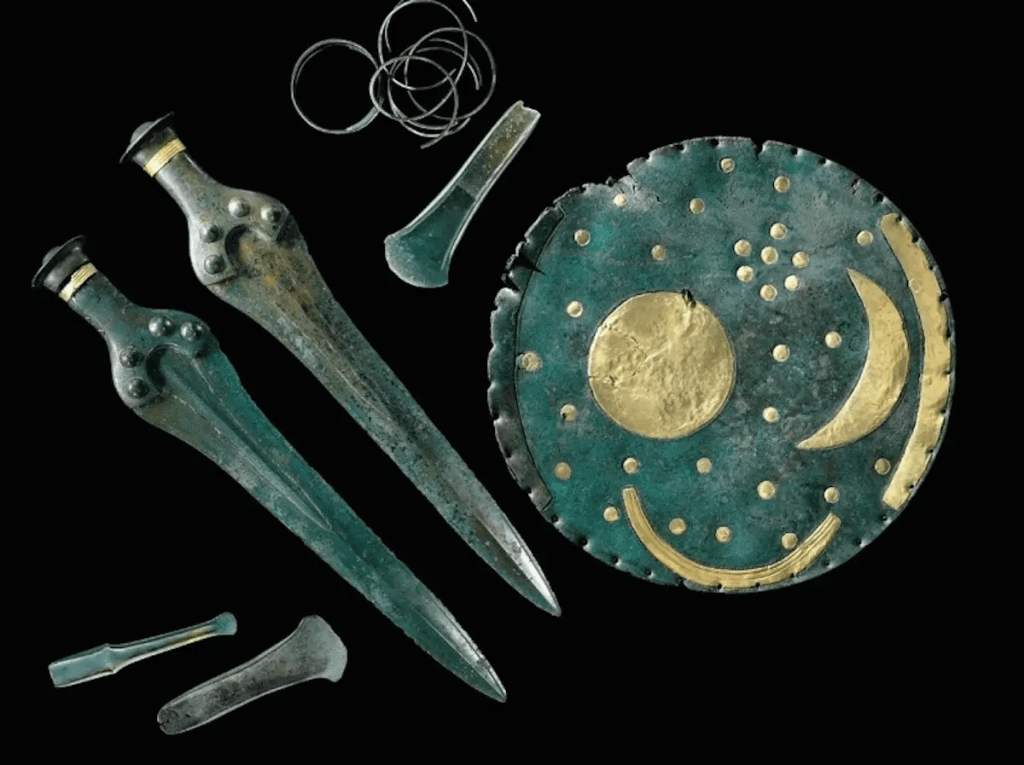
How was the Nebra Sky Disc discovered and who by?
Our story begins on Mittelberg Hill in the Saxony-Anhalt region of Germany, around 60km west of Leipzig. The year is 1999 and metal detectorists Henry Westphal and Mario Renner discover treasure, a horde consisting of two bronze swords, two hatchets, a chisel, fragments of spiral bracelets and a disc. The two men were operating without a licence, which meant that their activities were considered looting and illegal. They also damaged the disc with their spade and parts of the site. In Saxony-Anhalt, archaeological artefacts are property of the state so the items are their legal property, not the looters, even if they had their licence so the very next day, in Cologne, the two men sold the entire horde for 31,000 Deutsche Mark.
Over the next two years, the horde changed hands within Germany presumably several times, eventually being sold for up to one million Deutsche Mark on the black market. Finally, in February 2002, Harald Meller, the state archaeologist, acquired the items in a police-led sting operation in Basel from a couple who had put it on the Black Market for 700,000 Deutsche Mark.
Eventually, the original finders were traced and, in a plea bargain, they led police and archaeologists to the discovery site. Archaeologists opened a dig at the site and uncovered evidence that supported these claims; in the ground, there were traces of bronze artefacts and the soil matched samples found clinging to the artefacts.
The looters received sentences of four and ten months from a Naumburg court in September 2003. They did appeal these but the Court actually raised their sentences to six and twelve months.
The disc and accompanying finds are now at the State Museum of Prehistory in Halle but it has been loaned out to the British Museum for their World of Stonehenge exhibit which is running from February 2022 to July 2022. I was lucky enough to be able to go and visit this exhibit in February 2022 and see the Nebra Sky Disc with my own eyes and the rest of what is an incredible exhibition.
Where was the Nebra Sky Disc discovered?
The discovery site on Mittelberg Hill is in the Ziegelroda Forest and the surrounding area is known to have been settled in the Neolithic era, with approximately 1,000 barrows, which are ancient burial mounds, being in the forest. The site is right next to the town of Nebra, which is where the name of the disc is taken from.
What is the Nebra Sky Disc?
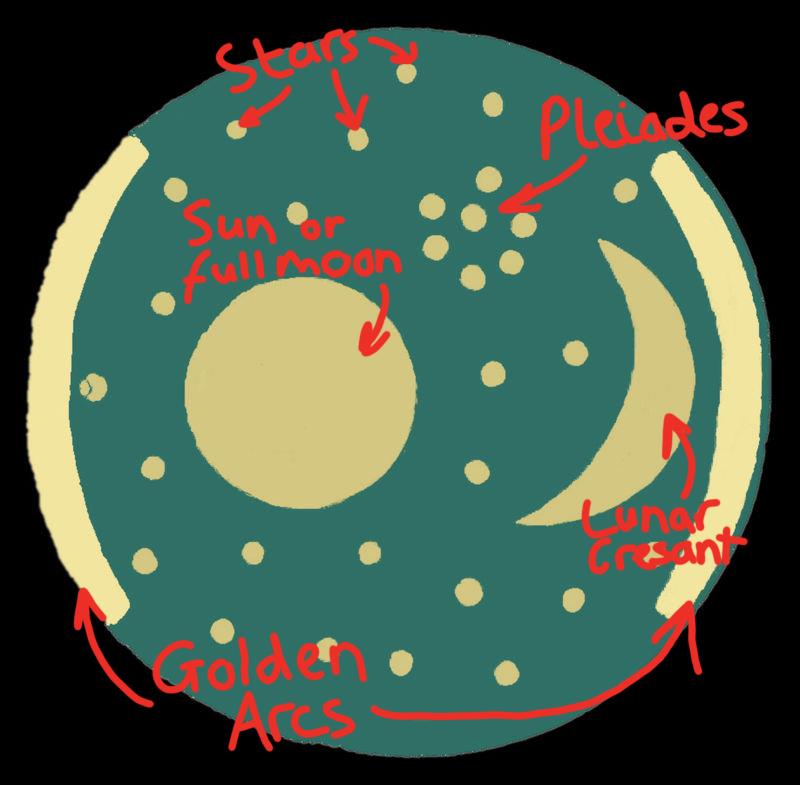
It is a bronze disc of around 30cm in diameter and weighing 2.2kg with a blue-green patina and inlaid with gold symbols. The disc was developed in four stages, including as it was preserved, with each stage adding additional symbols or marks. Generally, these symbols are interpreted as the sun or full moon, a lunar crescent and stars, including a cluster of seven which is thought to be the Pleiades.

Two golden arcs were added later at the sides to mark the angle between the solstices.
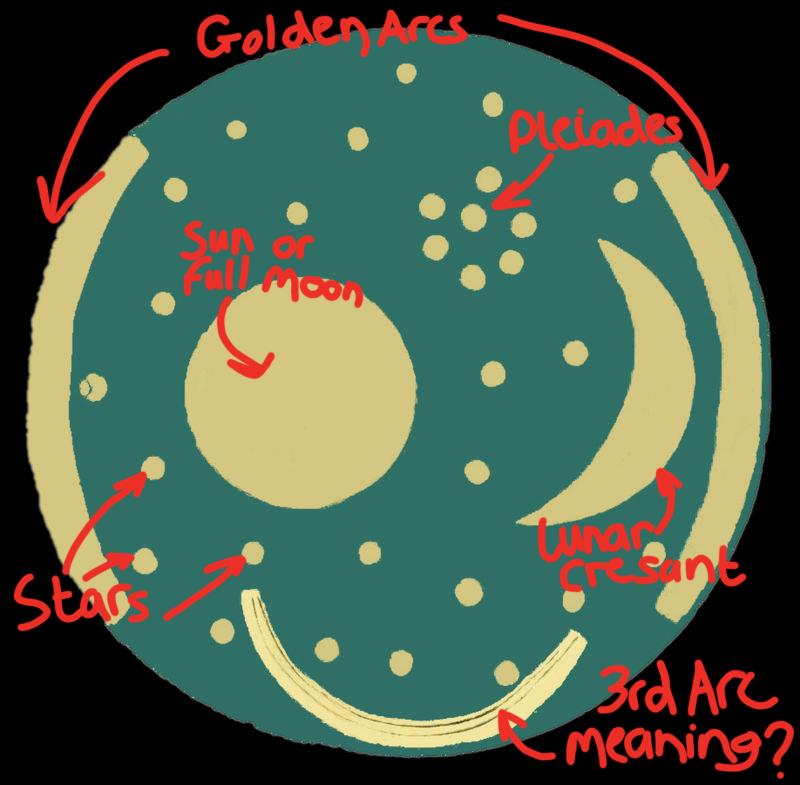
Then another arc at the bottom with internal parallel lines. The meaning of this final one is uncertain with suggestions including a solar barge, the Milky Way, a rainbow or the Aurora Borealis.
By the time the disc was buried it also had thirty-nine holes punched into the diameter, each approximately 3mm.
What is the Nebra Sky Disc made out of?
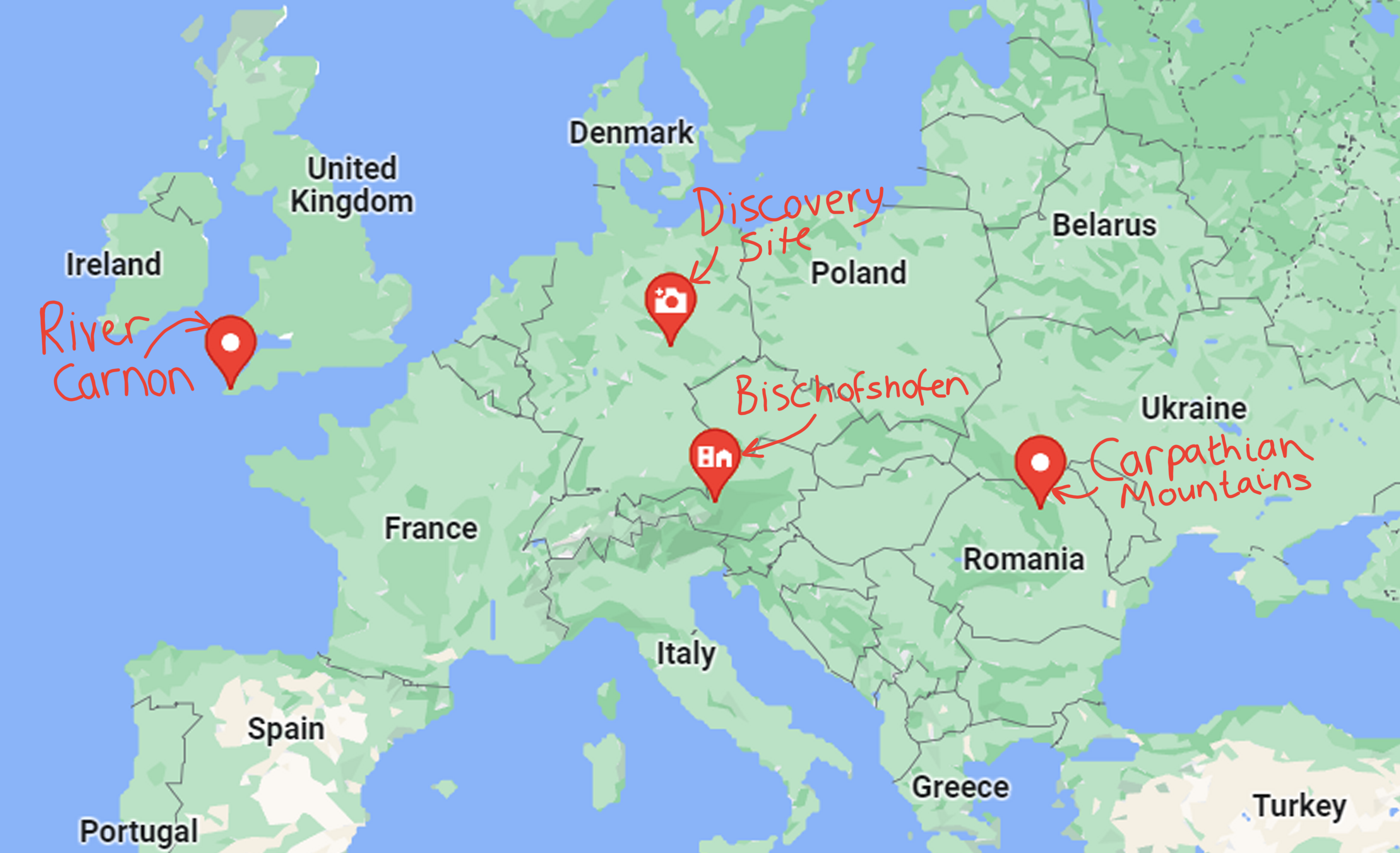
According to an initial analysis of trace elements by x-ray fluorescence, the copper used to make the disc originated at Bischofshofen in Austria, whilst the gold was thought to be from the Carpathian Mountains. A more recent analysis found that the gold used for the first symbols was from the River Carnon in Cornwall, England and the tin present in the bronze is also of Cornish origin.
What does the Nebra Sky Disc do?
The disc may be an astronomical instrument used to calculate planting and harvest time. It may have also been an item of religious significance and the blue-green patina may have been an intentional aspect of this.
How old is the Nebra Sky Disc?
The Nebra Sky Disc is widely believed to be 3,600 years old, dating from to c.1600 BCE in the Bronze Age. In the past the authenticity of the disc has been called into question with suspicions it might be an archaeological forgery, however, it is now accepted as authentic. This precise dating of the disc depends upon the dating of the accompanying items that it was supposedly found with. The axes and swords can be typologically dated to the mid-second millennium BCE and the radiocarbon dating of a birchbark particle found on one of the swords between 1600 and 1560 BCE further confirms this dating. This date corresponds to the date of the burial of the horde and it is believed that the disc had been in existence for several generations before this. If this Bronze Age dating is correct, the Nebra Sky Disc is currently the oldest known depiction of the cosmos and is regarded to reconfirm the astronomical knowledge of European bronze age people.
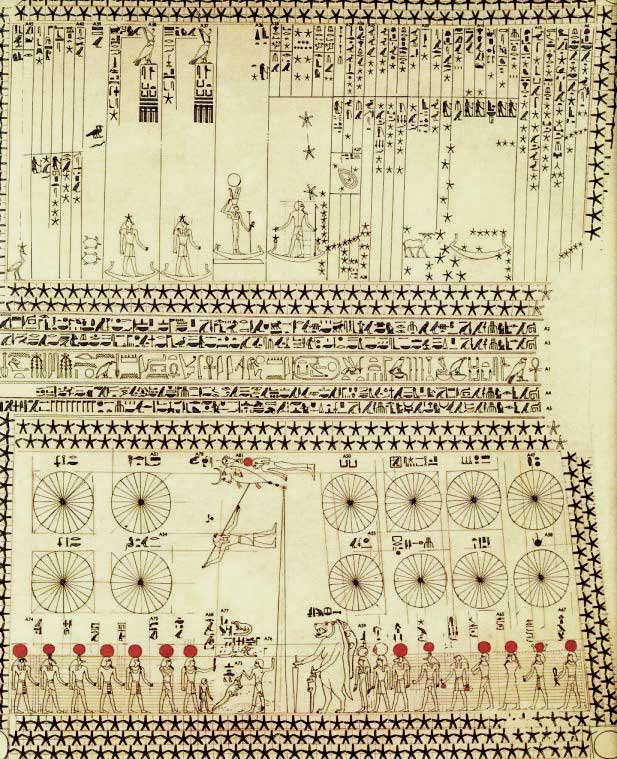
However, research published in 2020 by archaeologists from Goethe University Frankfurt and Ludwig Maximilian University of Munich challenges this dating. After they re-evaluated prior research and the conditions of the disc’s discovery, the researchers argue that the disc was likely not part of the horde of Bronze Age weapons it was said to be found with so it cannot be dated by using these artefacts. The researchers instead place the disc’s origins in the first millennium BCE as it bears hallmarks of an Iron Age item. This younger age would change the significance of the disc and the crown of being the oldest known depiction of the cosmos would instead go to Senenmut, a star clock in a grave’s wall painting found in Thebes, Egypt, which is dated to 1463 BCE.
By Louise Bedford


 Louise Bedford
Leave a reply to suburban tracker Cancel reply