
I have been trying to get back in touch with my creative side and I have always loved drawing but never really painted. Being a perfectionist though I have never wanted to commit to doing a full canvas painting as what if it doesn’t look good. Yet recently perfectionism is something I have wanted to get over and just do what I want to do. I bought some cheap art supplies from Søstrene Grene, that then just sat as I couldn’t decide what to paint. I had been working on a university essay on Çatalhöyük compared to Mohenjo-daro and while discussing this and my want to paint something my friend suggested why not paint the volcano wall mural found at Çatalhöyük. This was a brilliant idea and has now sparked my new found love of art and it isn’t perfect but that is okay as I love it and it was just for me to do for fun. Archaeopainting has been super fun as it has given me endless ideas of what to paint and is allowing me to consider these finds from a new perspective while also just having fun and being creative. In this blog post, I thought I would discuss the volcano wall art from Çatalhöyük while also sharing my new found rekindling with art and sharing the message screw being perfect just have fun. Hopefully this inspires you and let me know any other archaeopainting ideas!

Çatalhöyük is located in modern-day Turkey and is an archaeology site where occupation began in 7,100 BCE in the Neolithic spanning across two mounds. The East mound was first until 6,100 BCE when there was an overlap of occupation with the newer West mound, which then became the sole area until the 6th millennium BCE. It is very significant because it is a unique example of early agricultural life and provides insight into how villages shifted into urban settlements. There was also a sheer number of art discovered at the site.

Other than being beautiful, this mural is significant for other reasons as well. It is commonly believed to be an image of the Hasan Dag˘ volcano erupting, which is located 130km NE from Çatalhöyük. This would have been a really momentous event for the people living at Çatalhöyük because it was near this volcano they sourced obsidian, which was the common material for tools made at the site, and an eruption would most likely have effected this.
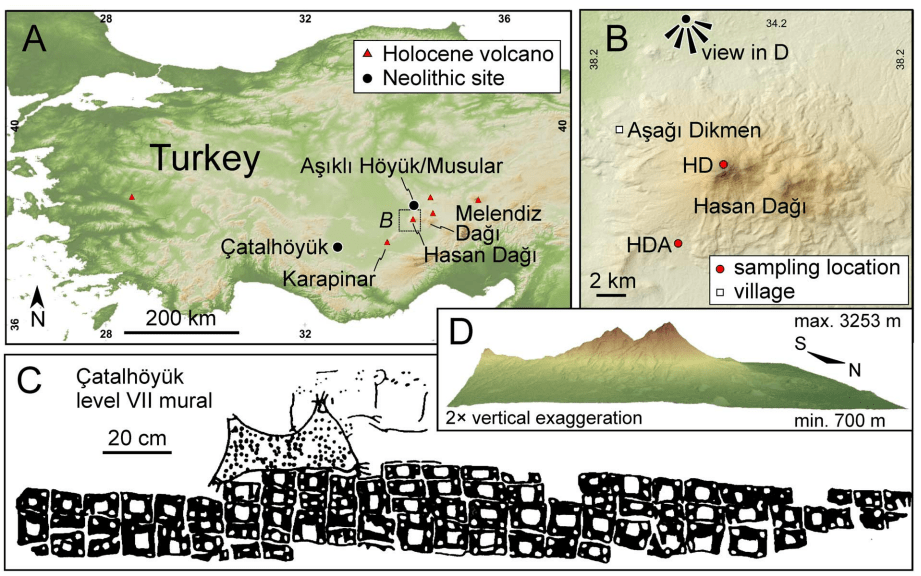
This conclusion had been contested as there was no evidence for an eruption during the period of occupation at Çatalhöyük. However, research performed by Schmitt et al. (2014) did discover samples of andesitic pumice veneer, this a type of volcanic rock only formed when lava erupts from a volcano. These samples were then dated and the results showed it was possible inhabitants of the site did witness an eruption from this volcano.
World’s first map?
The mural may not only be the oldest known depiction of a volcano but it has also been suggested this is the oldest map, depicting the volcano location and a plan of the town. The part of the image below the volcano has been interpreted to be a bird’s eye town plan of Çatalhöyük. When compared to the excavation plans of Çatalhöyük and the reconstructions of the site you can kind of see this.
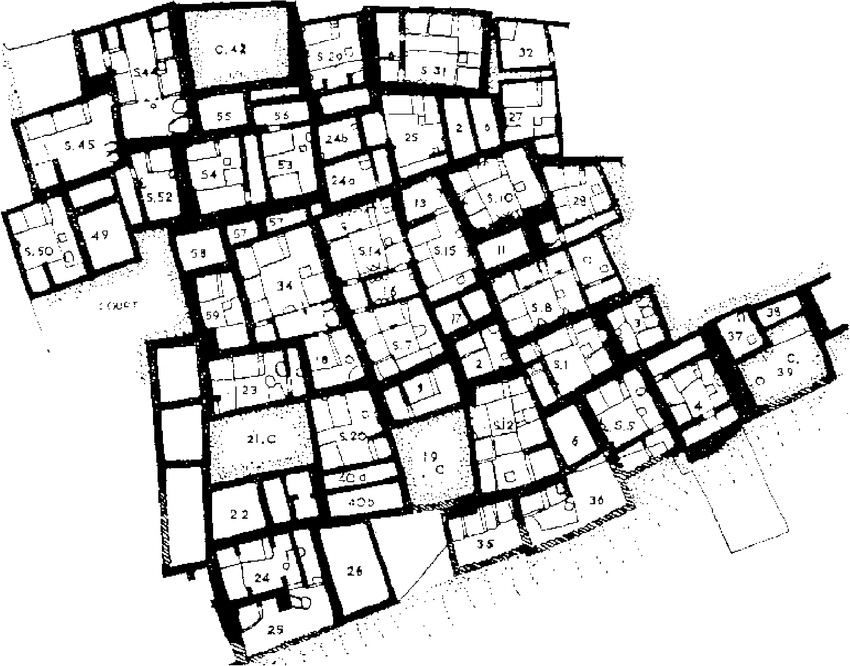

However, the entire mural has also been interpreted as a leopard’s skin and geometric pattern so it is very much open to interpretation! Thank you for reading this post, what do you think this wall mural represents? Comment below or follow me and let me know on Instagram, TiktTok (@louisearchaeology) or Twitter (@louisearchaeo).
References & Further Reading
Çatalhöyük Research Project www.catalhoyuk.com/project/history
Meece, S (2006) A Bird’s Eye View — of a Leopard’s Spots: The Çatalhöyük ‘Map’ and the Development of Cartographic Representation in Prehistory (pp. 1-16) Anatolian Studies www.jstor.org/stable/20065543
Schmidt et al. (2014) Identifying the Volcanic Eruption Depicted in a Neolithic Painting at Çatalhöyük, Central Anatolia, Turkey PLoS ONE doi.org/10.1371/journal.pone.0084711
 Louise Bedford
Leave a comment